How to Rank in Claude: The Complete Guide to GEO
Claude's search integration represents the future of information retrieval. To dominate, you need to transition from traditional SEO to Generative Engine Optimization (GEO).
TL;DR: The Claude Ranking Secret
Unlike Google, Claude prioritizes Entity Authority and Cross-Platform Verification. Your website alone is no longer enough; a significant majority of top Claude results involve brands verified across multiple platforms like Reddit, Quora, and high-authority PR sources.
Google SEO vs. Claude Ranking (GEO)
| Factor | Google SEO | Claude GEO |
|---|---|---|
| Primary Signal | Backlinks | Entity Verification |
| Freshness | Topic Dependent | Critical (30-day cycle) |
| Authority Source | Domain Authority | Cross-Platform Citations |
| Technical Focus | PageSpeed & Mobile | LLM-Friendly Schema |
The Five Pillars of Claude Ranking
Entity Authority
25% ImpactYour brand's verified presence across platforms like Reddit, Quora, and industry news.
Topical Relevance
20% ImpactSemantic alignment and comprehensive topic coverage via interconnected content clusters.
Engagement Metrics
20% ImpactInteraction depth, dwell time, and behavioral signals from real users.
Trust & Security
20% ImpactHTTPS security, transparent authorship, and consistent business information.
Content Freshness
15% ImpactRegular updates and responsiveness to industry developments within 30 days.
When Does Claude Search the Web?
Claude doesn't trigger a fresh search for every query. It strategically uses its training data for historical facts while initiating real-time searches for dynamic information.
Claude Searches For:
- • Current events & breaking news
- • Specific product comparisons & pricing
- • Time-sensitive technical data
- • Latest industry trends (2025-2026)
Claude Uses Training Data:
- • Historical facts & timelines
- • Established scientific concepts
- • Foundational coding principles
- • Older case studies & literature
The "Claude Circuitry": How the Model Plans Answers
Groundbreaking research from Anthropic into model interpretability reveals a startling truth: Claude doesn't just predict the next word - it plans its thoughts on a much longer horizon.
By tracing the "circuits" that underlie Claude's thinking, researchers have found evidence that the model calculates its destination many words in advance. This means that to rank, your content must satisfy Claude's internal logical roadmap.
- Long-Horizon Thinking: Claude plans its semantic path before the first word is even output - ensuring consistency across complex responses.
- Interpretability: New methods allow us to see how Claude uses specific patterns to form surprising connections many steps ahead.
1. Multi-Platform Authority Strategy
Claude evaluates your total digital footprint. Brands appearing consistently across platforms accumulate verification signals faster.
Daily Signals
- Reddit Community Answers
- Quora Expert Positioning
- LinkedIn Industry Commentary
Weekly Signals
- 2-3 Long-form Blog Posts
- 1-2 Video Case Studies
- Podcast Appearances
Pro Tip: Citation Stacking
"Don't just aim for one big press mention. Claude looks for volume and consistency. Being mentioned in 15+ listicles and resource guides monthly creates a 'citation stacking' effect that signals total market dominance to the LLM."
2. Technical Optimization: LLM-Friendly Schema
Claude requires structured data optimized for high-speed parsing. Standard Google schema is the floor; advanced LLM schema is the ceiling.
3. Topic Cluster Architecture
Claude rewards sites that "own" a topic through interconnected content clusters. This signals topical authority more effectively than isolated pages.
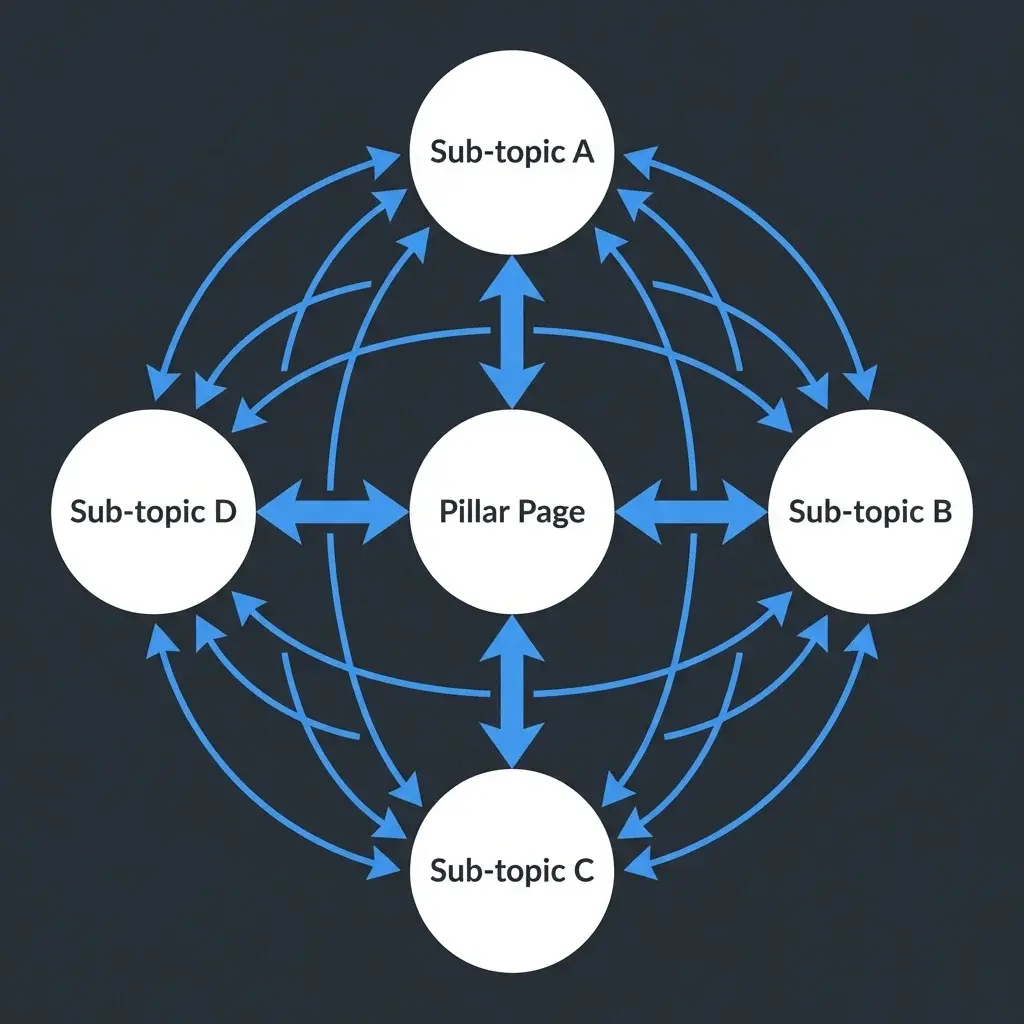
Fig 1: A semantic web showing multi-directional internal linking between the Pillar Page and Sub-topic clusters.
For example, within this AI search topic cluster, we would, should and could link to "How to Rank in ChatGPT" and "How to Rank in Perplexity," as these are relevant to the parent topic and pillar page, AI search.
Case Study: 6-Month Visibility Sprint
A B2B SaaS company implemented this exact GEO framework, focusing on topic clusters and citation stacking across Reddit and industry forums.
Claude Localization & Optimization FAQs
Google ranks static pages primarily based on backlinks and domain authority. Claude prioritizes brand verification across multiple platforms and real-time authority signals. Optimized brands generate continuous authority signals rather than just relying on a static high-authority domain.
The top five factors are Entity Authority (25%), Topical Relevance (20%), Engagement Metrics (20%), Trust Signals (20%), and Content Freshness (15%).
No. Claude uses training data for historical facts and established concepts, but it triggers a web search for current events, product comparisons, and time-sensitive information. To rank, you should optimize for queries that trigger searches.
Frequently. Many top-ranking Claude results have seen updates within the last 30 days. Regular refreshes help maintain citation momentum.
LLM-friendly schema is critical. Priority types include Organization, Person, Article, FAQPage, and LocalBusiness schema to provide structured verification.

References
- • Anthropic Research: "Tracing Thoughts in Language Models"https://www.anthropic.com/research/tracing-thoughts-language-model
- • PageOptimizer Pro: "Claude AI for SEO"https://www.pageoptimizer.pro/blog/claude-ai-for-seo
- • Passionfruit: "How to Write an SEO Optimized Article with Claude"https://www.getpassionfruit.com/blog/how-to-write-an-seo-optimized-article-with-claude-4
- • Julian Goldie (2026): "Generative Engine Optimization (GEO) Ranking Factors"
- • Accountabilitynow (2025): "Research on LLM Citation Momentum"